Grading cards is hard if you don’t have a plan.
How often do you see a post of someone pulling a card out of a pack and then immediately asking if they should grade it, or even worse – just by the cards I’ve seen graded – shipping it off to PSA without doing a single calculation.
Months later, the card comes back a beautiful PSA 10—awesome! Only to watch it sit listed for sale without a nibble.
Congrats. Fifty bucks to learn a lesson. (I’ve been there.)
I understand there are bulk reasons to grade such cards, but for the most part, grading shouldn’t only rely on “is this card in good enough condition to grade?”
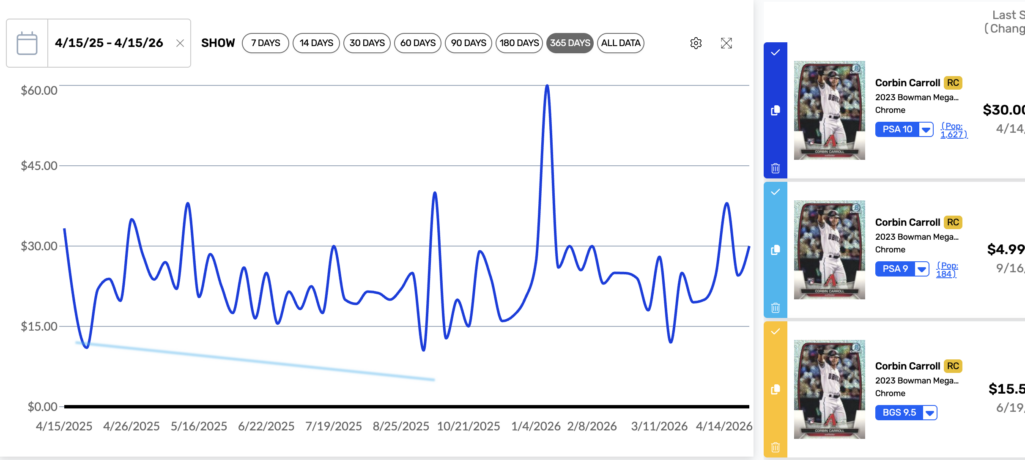
While it’s a key piece of info, so is “does the math actually work here?”
Those are completely different things.
A card can be mint, objectively gorgeous, worthy of a slab in every aesthetic sense, come back a 10, and still be a terrible financial grading decision.
The raw-to-graded spread has to justify the cost. Full stop. If it doesn’t, you’re essentially paying for the slab as a display piece, which is fine if that’s your thing, but it shouldn’t feel like a business move.
Here’s what most collectors skip: grading costs money. Seems obvious, but hear me out.
By the time you factor in submission fees and return shipping, you’re looking at a fifty-dollar floor just to break even. That means a PSA 9 needs to sell for at least fifty dollars more than the raw version, or you’ve already lost.
The gem upside – the chance it comes back a 10 – is how you actually make money. But the gem rate isn’t the same for every card. A vintage rookie might grade a 10 one time in one thousand submissions. A modern card might pop gems at fifty percent. Those odds matter enormously.
All of this and we aren’t even considering that grading takes a lot of time, which makes things really tough in a market that can shift daily.
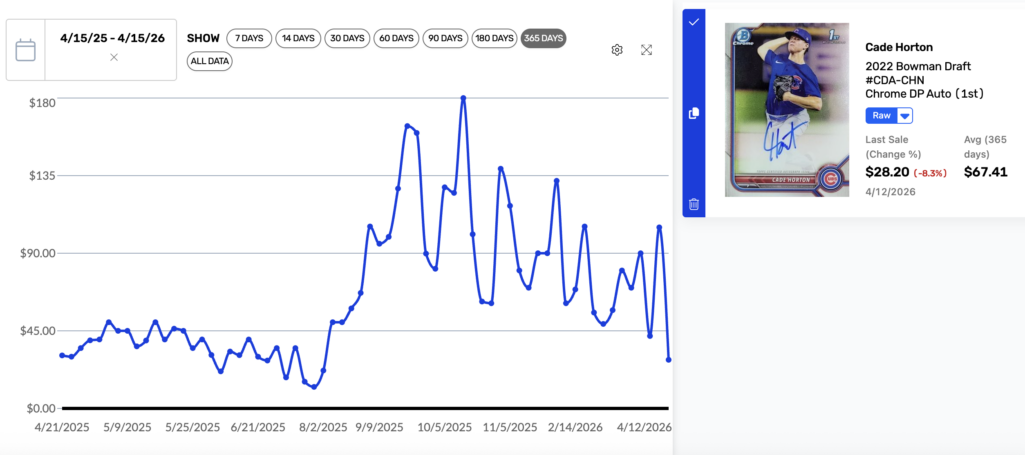
But here’s what kills most grading decisions: checking last-sale comps instead of live listings.
Nobody cares what a card sold for three weeks ago. You care whether you can sell it at the number you need, right now, to someone with cash and a wallet open. That’s eBay. That’s the real market. If a card sold for $250 last week but is currently listed at $175, good luck selling at $250.
So I’m starting this series to work through the actual math with you. I’m going to pull cards where the raw-to-graded spread looks unusually wide—cards that Market Movers is flagging as a potential favorable ratio. Then I’ll grab live eBay data for raw copies, PSA 9s, and PSA 10s. I’ll pull the gem rate from PSA’s population reports. And I’ll give you a straight answer: Grade It, Grade If (conditions apply), or Pass.
Now, assumptions—I’m assuming you’re confident your copy can hit at least a 9. The question we’re answering is whether that 9 still pencils out financially, with the 10 as your bonus upside.
If you’ve got a card sitting on your desk right now that you’re wondering about, send it my way. Let’s work through it together.
First Up: Paul Skenes 2024 Topps Chrome Update Negative Refractor
The Numbers

You’re looking at a 2024 Topps Chrome Update Paul Skenes Negative Refractor USC88 that’s in gradeable condition. The question isn’t whether grading is worth it at a PSA 10—it clearly is. The real question is simpler: does the math pencil out even if your card grades PSA 9?
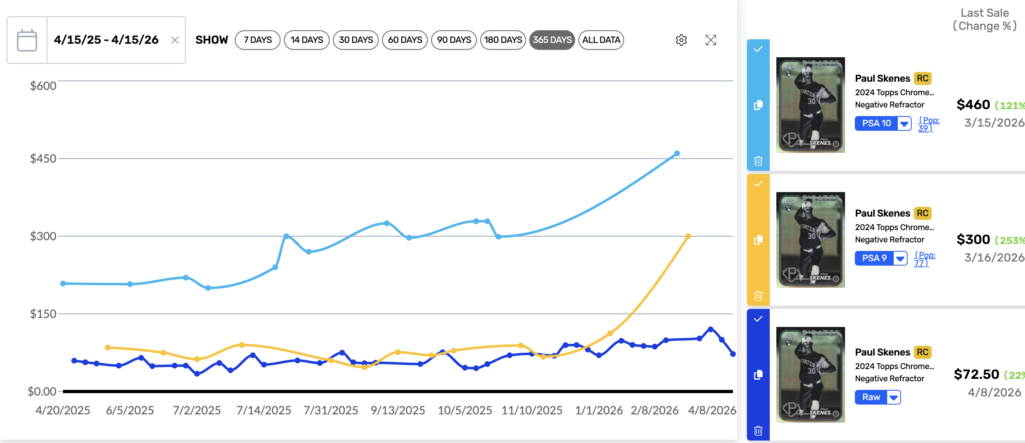
Last sales of this card in PSA 10, PSA 9, and raw condition, according to Market Movers:
But remember, the past has passed.
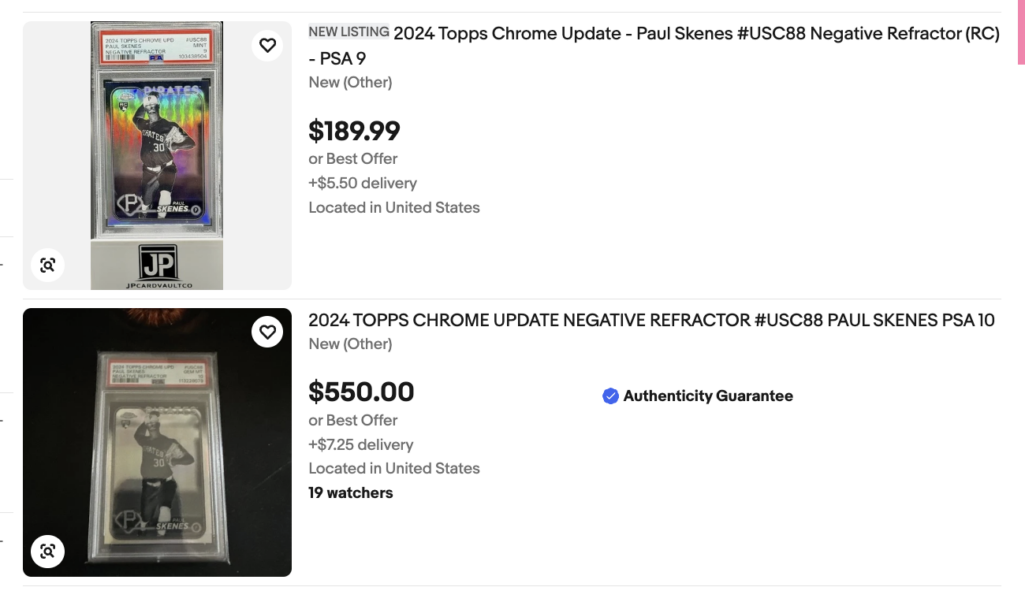
Right now, one raw copy is at auction on eBay. There is a PSA 9 listed at $189.99, and a PSA 10 at $550.00.
What that means: if raw sells for around $100, there’s genuine value separation between raw and graded, which improves your case for submitting.
The Gem Rate
According to Gem Rate, of the 141 graded copies tracked across PSA, 39 came back as Gem Mint 10s. That’s a 27.7% gem rate.

In plain terms: A little more than one in four copies that gets submitted hits the ceiling. That’s not a guarantee, but it’s a meaningful probability if you’re confident your copy is top-tier.
The Math
Here’s the decision framework. PSA grading costs $50 all-in (including return shipping). Add that to your raw cost of $99.95 and you’re at $149.95 out of pocket.
Floor scenario: Your card grades PSA 9. Current eBay listing for that grade is $189.99. Net profit: $40.04. You recover your grading fee and still pocket $40. (Again, there is always the chance it grades lower than a 9).
Ceiling scenario: Your card grades PSA 10. Current listing is $550.00. Net profit: $400.05. That’s a genuine jump in upside. (Again, assuming you can sell tat that price. In all reality, it will probably be a little lower, if anything. It’s also not knowing what will be listed months down the road when you get your cad back).
Here is what I’m looking for: the break-even point is already behind you at PSA 9. You’re profitable even in your worst likely case.
Verdict
If I’m confident in condition, I’d personally grade it based on today’s listings. The math works cleanly. Even if I only hit PSA 9, I clear $40 after paying for grading. A PSA 10 gives you another $360 on top of that. Since your floor is profitable and your upside is meaningful, the risk-reward tilts in your favor. Submit with confidence.
How I run the numbers: This analysis assumes you’re confident your card grades at least a PSA 9 — meaning PSA 9 is the worst case, not the expected outcome. The Floor shows your net profit or loss if you get a 9 AND sell at what a PSA 9 is currently listed for on eBay. The Ceiling shows what you clear if you hit a gem (PSA 10) AND sell at what a PSA 10 is currently listed for on eBay. The gem rate (from GemRate population data) tells you how often other copies have graded out as 10s—it’s not a guarantee, but it’s the best signal we have for your odds of hitting the upside.
| Data Point | Value |
|---|---|
| Raw — Last Sale (Market Movers) | $72.50 |
| Raw — Lowest Listed (eBay) | Auction |
| PSA 9 — Last Sale | $300.00 |
| PSA 9 — Lowest Listed (eBay) | $189.99 |
| PSA 10 — Last Sale | $460.00 |
| PSA 10 — Lowest Listed (eBay) | $550.00 |
| Raw-to-PSA-9 Ratio | TBD |
| Total Graded | 159 |
| PSA 9 Rate | 54.6% |
| PSA 8 Rate | 16.3% |
| Gem Rate (chance of PSA 10) | 27.7% |
| Grading Cost (incl. return ship) | About $50 |
| All-In Cost | $149.95 |
| Floor: Net at PSA 9 | $+40.04 |
| Ceiling: Net at PSA 10 | $+400.05 |

Ryan Barone (“Ballcard Genius”) is a recognized sports card expert and lifetime collector. With nearly 27,000 TikTok followers and over 3,000 SubStack subscribers, Ryan loves talking cards, dishing tips, and building hobby communities. hello@ballcardgenius.com; Last Time Ago LLC dba Ballcard Genius.